Find me on Twitter, Facebook, Tumblr and Novel Spaces
I've been having some serious problems with the nasty spammers lately, which makes coming to this blog such a chore. Sad, I know.
And, to be honest, I haven't been keeping up with the blog as much as I'd like to. So I'm officially semi-closing down this blog and moving to another venue.
If you're looking for just a snapshot of what's going on in my world, find me on Twitter and Facebook.
For those things that require a bit more than 140 characters, jump over to my new page on Tumblr. Well, it's kind of new. I've actually been having it for well over a year, but never posted to it. I am now!
And if you still don't have enough of me, I'm still blogging twice a month at Novel Spaces. You can catch me there on the 1st and 17th of every month.
Okay, so I'm pretty sure by now they've unearthed another thousand of Emperor Qin's army of terracotta warriors, but life has been super busy lately. However, seeing the remake of The Karate Kid, a classic from my childhood, had me reminiscing about my fabulous trip to China, and I realized I still had not posted about one of my very favorite, and most anticipated parts of the trip.
Located just outside the city of Xi'an in China's Shaanix province, The Terracotta Army is simply one of the most amazing sights I've ever seen. It was one of the highlights of my trip.
Without further ado, the Terracotta Warriors:
This pit, Pit #1, is the largest of several that have been unearthed. So far, over 2000 warriors have been excavated, but there is an estimated 4,000 to 6,000 still buried in the enormous tomb of Emperor Qin. His actual burial place is over a mile away from where the Terracotta Army, which was built to guard him in the afterlife, was found.
My aunt and I took several trick camera shots with the warriors. I call this one "Good Little Soldier Boy." Brings back memories of junior high 4-H. I'm pretty sure someone would be shot on the spot if they tried to climb into the pit and touch the soldiers.
According to our tour guide, we were extremely lucky to visit the tomb on a day when the excavators were working. The tour guide had been to the site well over a hundred times, and this was his first time seeing the archeologists in action. The black you see is the ash from when the tomb was raided and burned several thousand years ago.
Several of the more complete statues are displayed in glass cases that allow visitors to really see the meticulousness that went into carving them. The detailing of these warriors is absolutely fascinating. Even more fascinating is that no two warriors are alike; every single one has different facial features.
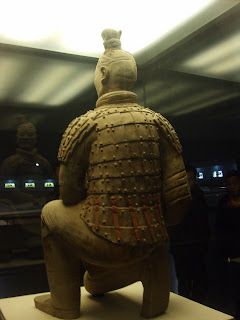
The Kneeling Warrior is one of the most famous of the terracotta warriors. This particular warrior was well preserved and is one of the few that still has some of the color. Take a look at his armor; you'll see the traces of red. Before visiting the tomb, I had no idea the warriors were so elaborately painted.
You can see the detail of the warriors here. Check out the treads on the sole of the warrior's sandal. It's amazing to think of how long this took, especially when you think of the limited tools at the peoples' disposal at this time. It's estimated that around 700,000 people worked to build the tomb, and many were killed to protect the privacy of the emperor once it was done. Did I mention this emperor wasn't the nicest dude on the planet?
Something that isn't talked about much are the Bronze Charioteers. Several of these chariots were discovered in the caves as well. Again, the detailing was simply breathtaking.
Here's a close up of the charioteer. Unlike the life-sized terracotta warriors, the chariots are much smaller in size.
The highlight of my day was meeting and getting a picture with the farmer who discovered the pit in 1974 when drilling a well in search of water. He isn't always at the pit, so again, we were extremely lucky. Not only did I get a picture, but he also autographed the book I bought on the Terracotta Warriors.
When I decided to visit China, there were two things on my "must see" list: The Great Wall and the Terracotta Warriors. Neither of these disappointed. I still get goosebumps just thinking about the time I spent here.
I eventually want to post about visiting China's Cave People, which was also in Xi'an, and at least one post of the city that I refer to as "New York on Steroids": Shanghai.
I know, I know, if my blog were my child Social Services would be knocking at my door, but the neglect won't continue for long. I promise to carve out more time. In the meantime, do drop by at Novel Space ever so often or follow me on Twitter if you're really up for some inane babble (warning, it reaches a new level there).
Yes, I know that I still haven't posted the rest of my China Adventures posts. There's no excuse other than life has been kicking my butt lately. I foolishly thought I'd have more time once I quit my day job.
In the mean time, hop on over to Novel Spaces where I'm blogging today about why I hate reading my own books once they've made it to actual book form. Here's a hint: once it becomes an actual book, I can't change anything! Grrr!
Let me know what things you'd like to "do over" if you had the chance!
I'm blogging over at Novel Spaces about conferences and conventions. Share some of your favorites with me. Let me know what you look forward to when it comes to writing conventions and all the great opportunities they provide!
P.S., I know I'm woefully behind on my China Adventure post, but real life has been crazy busy. Promise to get back to it.
I know I promised the next blog post would be about the Terracotta Warriors, but I forgot that the itinerary was changed at the last minute. So, in staying true to the actual itinerary of the trip, I will continue on with what we accomplished the following day when we took an overnight train ride through the China countryside from Beijing to the fabulous city of Xi'an.
One of the reasons I wanted to visit China is because it is so very old and full of history. The oldest, most historic city we visited was Xi'an. Our fantastic tour guide, Chang Quay, told us that there is a saying: "If you want the last 500 years of China, go to Shanghai. If you want the last 1000 years, go to Beijing. If you want the last 5,000 years, go to Xi'an."
Xi'an was everything it promised to be. Rich in ancient culture and teeming with historical sites. It is the only major city in the entire country that is still fully surrounded by a city wall, which was still decorated for the country's Lantern Festival. Unfortunately none of the pictures I took of it came out. :( They were all from a moving bus, so yeah, they're not pretty.
However, I have tons of pictures of the famous Wild Goose Pagoda, which is where we went our first day in Xi'an. This structure is over 1300 years old, and has never had any restoration work done to it. Can you even wrap your head around something that old? The U.S. is less than 250 years old. Just this building is more than five times older than our country. Amazing!
Here I am in front of the Wild Goose Pagoda on what was a very gloomy day. It was fitting since we were visiting a holy place. That black tea kettle-looking thing in the background is actually an incense burner.
Here's a better picture of the pagoda without me blocking it. It truly was amazing.
Though a busy tourist attraction, the Wild Goose Pagoda is still a functioning temple. There were several people who came to worship while we were there.
This is inside the temple. We couldn't walk in it, of course, but we could take pictures from the outside. Like so many things I saw in China, photos just do not capture the beauty. All the gold you see here is 100% real. It was absolutely AMAZING! Something you have to see with your own eyes to really appreciate.
This was one of three murals made completely out of jade. No, it's not just green. The jade stone comes in a multitude of colors. The detail of these murals was simply magnificent. Again, you've got to see it in person.
We were extremely lucky during our trip to the pagoda. Not only did we get to see one of the Buddhist monks who lives there, but we got to see the second highest ranking monk. According to our tour guide, this was very rare, indeed.
During our first day in Xi'an we also visited the Shaanxi History Museum, where I got to see actual Ming vases from the Ming dynasty. Unfortunately, those pictures also were not that great. Guess you'll just have to take a trip to China to see them for yourself. :)
I'd be remiss not to mention the devastation of yesterday's earthquake. Even though it was more than 1,000 miles from where we visited, it still affected me more than it would have had I not just visited the country last month. My thoughts and prayers are with the people of China.
Stay tuned for the next installment with amazing pictures of the Terracotta Warriors and the Cave People!
The third day in Beijing was a "free" day for those who were brave enough to explore the city on their own, but for cowards, like me and my aunt Cathy, who were too intimidated by the language barrier, you could take advantage of an optional tour of Beijing's historic District and tour the Temple of Heaven.
The two previous days, we had driven just outside the cement walls of the Hutong district, but I wasn't sure what to expect once inside. It is basically a city within the city. It is the oldest part of Beijing, and even though it appeared "run down" in parts, we were told that the real estate is some of the most expensive in all of Beijing. Because if you own a piece of the Hutong District, you own history.
Before heading to China, I had no idea what a rickshaw was. But since I was going to be touring a part of the city in one, I decided to look it up. Here's a rickshaw. And, yes, I toured the "Old City", Beijing's Hutong District, in one of them.
Here we are with our rickshaw driver. Poor guy had to work hard on that bike.
This part of Beijing truly is a city within the city. There are clubs, restaurants, coffee shops, hotels, and even a lake hidden within the cement walls of the Hutong District.
The interesting thing is that you cannot tell that any of this is hidden behind the crumbling cement walls that conceal the Hutong District from the rest of Beijing. It is like a hidden treasure!
What made this day extra special was the chance to visit an actual home and have lunch prepared for us by a local woman and her family. She gave us a dumpling-making demonstration, and we were each allow to make a dumpling. As usual, this home-cooked meal was soooooo much better than any of the food we had in restaurants. It was the best meal in Beijing.
Our hostess spoke no English, but the language barrier didn't seem to come into play at all. She was so warm and inviting.
My dumpling left much to be desired. Thankfully, hers were much, much better.
When we left the Hutong District, we headed for the Temple of Heaven. If it's one thing the people of China cherish, it is community. The Temple of Heaven is a beautiful garden of sorts where people can come in and just be together. There was one group singing traditional Chinese songs, and another group of retired women dancing, and even karaoke. It was a great slice of everyday Chinese life.
Young and old people joined in the singing. I couldn't understand a word of it, of course, but you don't have to understand the words to feel the music. It was lovely.
The Chinese women tend to retire around age 50 (jealous!!!) and to stay in shape, many of them participate in daily dance as a form of exercise. Anyone is invited to join in. I'd never seen anything like it.
People played cards and instruments, and others just watched and listened.
The "Hall of Prayer and Good Harvest" is the largest structure in the Temple of Heaven, and according to Feng Shui, it is the exact point where heaven and Earth meets.
I have so many great memories of this day. While The Great Wall of China had been the thing I most looked forward to in Beijing, this day of touring the city's historic district and seeing its people go about everyday lives was, by far, the best part of Beijing.
As an extra special treat, I have a bit of video from our Rickshaw ride. It really is one of those you-just-have-to-do-it-for-yourself experiences, but hopefully you can get a feel for it.
Next, we move on to the ancient city of Xi'an (pronounced Shee-an) which is most famous for its Terracotta Warriors. One word: PHENOMENAL!!! You will not want to miss this!